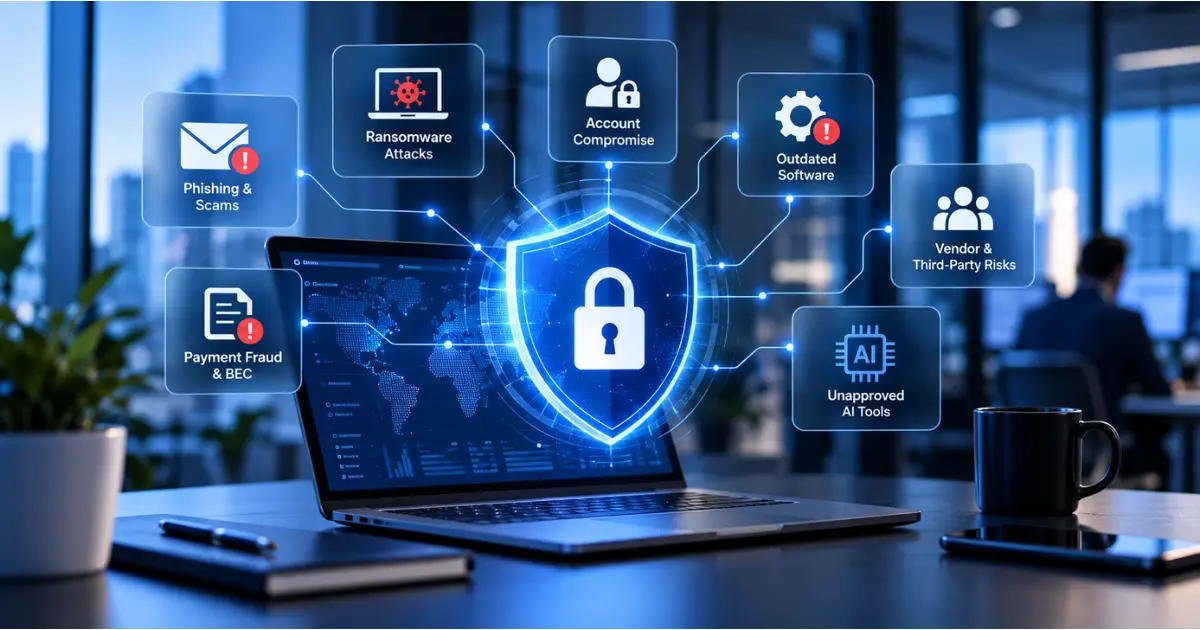
Cybersecurity is no longer a concern limited to large corporations. Small and mid-sized businesses increasingly rely on digital systems to manage operations, communicate with customers, process payments, and store sensitive information.
While technology makes everyday business activities more efficient, it also creates opportunities for cybercriminals.
A single compromised email account, outdated application, or fraudulent payment request can disrupt operations, expose confidential information, and result in financial losses.
In 2026, businesses face a combination of familiar cybersecurity threats and newer challenges involving artificial intelligence, cloud applications, and increasingly sophisticated scams.
Understanding these risks is the first step toward protecting your organization.
Why Are Small Businesses Vulnerable to Cyberattacks?
Small businesses often operate with limited IT resources, making it difficult to maintain the same level of cybersecurity oversight as larger organizations.
Many rely on a combination of cloud platforms, external software providers, employee devices, and business applications to manage their daily activities.
Each of these systems requires appropriate security measures, regular maintenance, and controlled access.
Cybercriminals may target smaller organizations because they handle valuable customer and financial information but sometimes lack dedicated security personnel or established protection procedures.
The consequences of an attack can extend beyond immediate financial losses. Businesses may experience operational downtime, lost productivity, damaged customer relationships, and additional recovery expenses.
For these reasons, cybersecurity should be treated as an ongoing business responsibility rather than a one-time technology investment.
The Biggest Cybersecurity Risks for Small Businesses in 2026
Although cyber threats continue to evolve, several common risks deserve particular attention from business owners.
1. Phishing and AI-Powered Scams
Phishing remains a common method used by cybercriminals to gain access to sensitive information or business systems.
These attacks typically involve fraudulent emails, messages, or websites designed to appear legitimate.
For example, an employee might receive an email that appears to come from a trusted software provider, asking them to update their account information through a link.
If the employee enters their credentials, an attacker may gain access to the account.
Artificial intelligence has made it easier for criminals to produce convincing messages, imitate communication styles, and create fraudulent content with fewer obvious mistakes.
How businesses can reduce the risk:
Train employees to recognize suspicious requests and unexpected links.
Enable multifactor authentication (MFA), preferably phishing-resistant methods where available.
Verify unusual requests through trusted communication channels.
Use appropriate email security and filtering tools.
Employee awareness is important, but it should be supported by technical safeguards that reduce the consequences of mistakes.
2. Ransomware Attacks
Ransomware is malicious software that can prevent organizations from accessing their systems or information.
Attackers may encrypt important files, steal confidential data, or threaten to release information unless a payment is made.
For a small business, a ransomware incident could interrupt access to customer records, accounting applications, internal documents, or essential operational systems.
Even when businesses have backups, restoring systems and investigating an attack can require considerable time and resources.
How businesses can reduce the risk:
Maintain secure backups and regularly test restoration procedures.
Keep operating systems, applications, and security tools updated.
Use endpoint protection and restrict unnecessary administrative privileges.
Develop a basic incident response and recovery plan.
Businesses should also understand which systems are essential to daily operations so they can prioritize recovery if an incident occurs.
3. Stolen Passwords and Account Compromise
Business accounts provide access to valuable information, including customer records, financial systems, emails, and cloud applications.
If attackers obtain an employee's login credentials, they may be able to access these systems without immediately attracting attention.
Credentials can be stolen through phishing, malware, data breaches, or insecure password practices.
Reusing passwords across multiple services creates additional risk because a compromised password from one platform may provide access to others.
Attackers may also attempt to steal active login sessions, allowing them to bypass some traditional authentication controls.
How businesses can reduce the risk:
Require unique passwords and encourage the use of password managers.
Enable MFA on business accounts.
Review account permissions and remove unnecessary access.
Monitor suspicious sign-ins and unusual account activity.
Businesses should also promptly disable accounts belonging to employees who have left the organization.
4. Outdated Software and Unpatched Systems
Software vulnerabilities can create opportunities for attackers to access business systems or disrupt operations.
These weaknesses may exist in operating systems, applications, servers, network equipment, or other connected technologies.
Software vendors regularly release updates to address known security issues. However, businesses that delay installing critical updates may leave systems exposed.
For example, an outdated remote access application or network device could contain a vulnerability that attackers can exploit to gain unauthorized access.
How businesses can reduce the risk:
Maintain an inventory of business software and connected devices.
Apply security updates promptly, prioritizing critical vulnerabilities.
Replace systems that no longer receive security support.
Conduct periodic vulnerability assessments.
A structured update and maintenance process can help businesses identify weaknesses before they become serious problems.
5. Third-Party and Vendor Security Risks
Most businesses depend on external providers for services such as cloud hosting, payment processing, customer management, and business communications.
While these relationships offer convenience and specialized capabilities, they can also introduce cybersecurity risks.
A security incident affecting an external provider may expose shared information or interrupt services that a business relies on.
Similarly, contractors and vendors with unnecessary access to internal systems can create additional vulnerabilities.
How businesses can reduce the risk:
Evaluate security practices before working with critical vendors.
Limit third-party access to the systems and information they need.
Review vendor permissions periodically.
Establish clear expectations for data protection and incident reporting.
Businesses should also consider how they would continue operating if an important technology provider experienced an outage or security incident.
6. Unapproved AI Tools and Data Exposure
Artificial intelligence is becoming part of everyday business operations.
Employees may use AI applications to draft communications, analyze information, summarize documents, or assist with administrative tasks.
However, using unapproved tools can create data security and privacy concerns.
For example, an employee might upload a confidential customer document to an AI platform without understanding how that information is processed, stored, or retained.
AI tools can also introduce risks through insecure integrations, excessive access permissions, or unreliable outputs.
How businesses can reduce the risk:
Establish clear policies for workplace AI usage.
Identify which AI tools employees are permitted to use.
Restrict the sharing of confidential or sensitive information.
Review data handling practices and application permissions before approving new tools.
AI can provide significant operational benefits, but businesses should adopt it with appropriate security controls and oversight.
7. Business Email Compromise and Payment Fraud
Business email compromise (BEC) is a form of fraud in which attackers impersonate trusted individuals or organizations to manipulate financial transactions or obtain sensitive information.
These attacks may involve compromised email accounts, fraudulent messages, or convincing impersonation attempts.
For example, a business might receive what appears to be a legitimate email from a supplier requesting that future payments be sent to a different bank account.
If the request is processed without verification, the funds could be transferred directly to a criminal.
Attackers may also impersonate executives and request urgent payments or confidential financial information.
How businesses can reduce the risk:
Independently verify changes to payment instructions.
Require additional approval for significant financial transactions.
Train employees to recognize unusual payment requests.
Protect business email accounts with strong authentication and access controls.
A simple verification procedure can provide an important safeguard against financial fraud.
How Can Small Businesses Improve Their Cybersecurity?
Protecting a business does not necessarily require implementing every available cybersecurity technology.
A more effective starting point is to understand the organization's risks and establish essential security practices.
Start With a Security Assessment
Review your current IT environment, including devices, applications, networks, cloud services, and user accounts.
Identify outdated systems, unnecessary access permissions, and areas where important information may be exposed.
Strengthen Access Controls
Require MFA, use secure password management practices, and ensure employees only have access to the information and systems necessary for their roles.
Maintain Systems and Backups
Keep software updated, monitor critical systems, and maintain secure backups that can be restored when needed.
Train Employees Regularly
Help employees understand common scams, recognize suspicious activity, and report potential incidents promptly.
Prepare for Security Incidents
Establish clear procedures for responding to compromised accounts, suspected malware, data exposure, and operational disruptions.
These measures cannot eliminate every threat, but they can significantly improve an organization's ability to prevent, identify, and respond to cybersecurity incidents.
When Should a Small Business Consider Professional Cybersecurity Support?
As technology environments become more complex, managing cybersecurity internally can become challenging.
Businesses may benefit from professional support when they lack dedicated IT security personnel, experience recurring security issues, or need help managing multiple systems and locations.
External cybersecurity specialists can assist with security assessments, vulnerability management, endpoint protection, monitoring, and incident response planning.
They can also help organizations establish consistent security practices and identify areas requiring additional protection.
The goal is not simply to install more security tools. It is to develop a practical approach that aligns cybersecurity measures with the organization's operations, resources, and risks.
Final Thoughts
Cybersecurity threats continue to evolve, but many of the risks facing small businesses can be addressed through consistent security practices and appropriate technical safeguards.
Phishing, ransomware, compromised accounts, outdated software, vendor vulnerabilities, AI-related data exposure, and payment fraud all deserve attention.
Businesses that understand these threats and take proactive steps to manage them are better positioned to protect their information, maintain operations, and respond effectively when incidents occur.
At Orbitz Technology, we help businesses strengthen their cybersecurity through security assessments, infrastructure protection, risk management, and ongoing technical support.
Our focus is on helping organizations identify vulnerabilities, protect critical systems, and build a more secure technology environment.
Ready to Strengthen Your Business Cybersecurity?
Explore how Orbitz Technology can help you assess security risks and improve your organization's protection.
KEEP EXPLORING
Explore more practical perspectives on technology, security, automation, and business growth.

Managed Services
Compare managed IT services with an in-house IT team to choose the support model that fits your business.
AI & Automation
See how practical AI automation can streamline everyday workflows, improve productivity, and support smarter operations.
Brand & Growth
Learn the warning signs that your website may be losing opportunities and where to focus your improvements.
LET’S CONNECT
Talk to Our Team